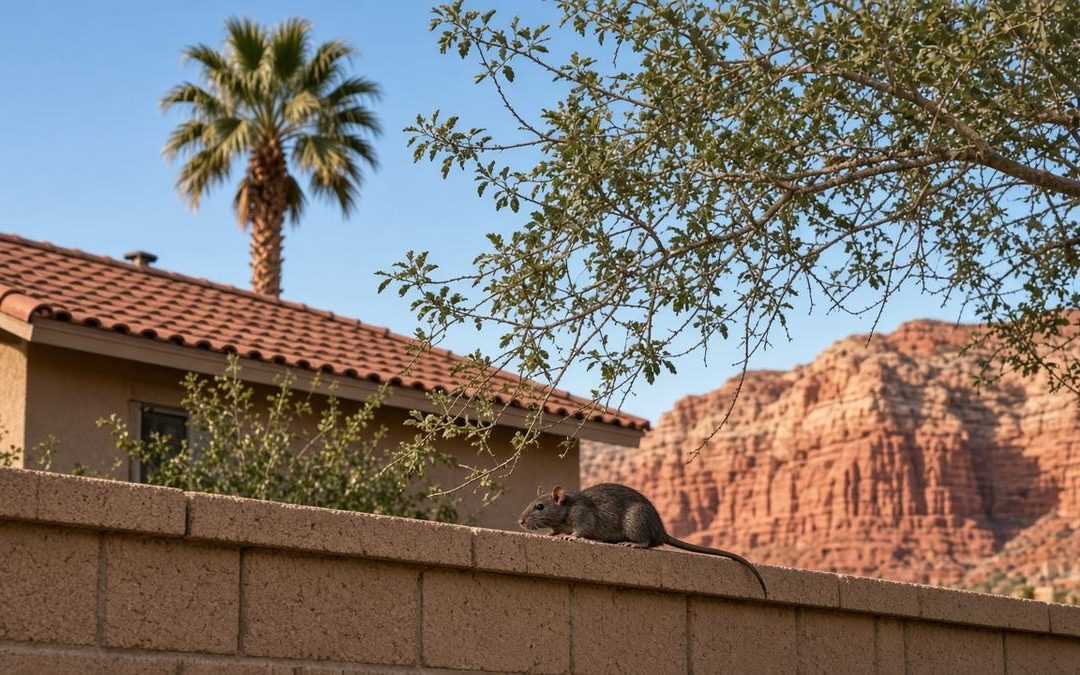
Hearing scratching in the ceiling at night? If you live in St. George, there’s a good chance it’s coming from above you, not under the floor. Roof rats in St. George Utah climb. They run block walls, fences, palm trees, and power lines, and they get into a house high, usually through the roofline or the attic. This post covers how to tell if you have them, where they get in, and what actually fixes it. The same advice applies in Washington, Santa Clara, and Ivins.
What roof rats look like and how they behave
A roof rat is a sleek, dark rat, about 6 to 8 inches long in the body, with a tail that’s longer than it looks like it should be. They’re excellent climbers. That’s the whole story with this rat: it lives and travels up high. Attics, upper floors, and the space above garage ceilings are where they like to nest.
That’s different from the Norway rat, which is bigger, heavier, and burrows along foundations and under slabs. If the noise is overhead and you see damage up high, think roof rat first.
Both are rodents we deal with on our rodent control calls, and both chew. Roof rats are hard on wiring, insulation, and anything you’ve stored in the attic.
Roof Rats in St. George Utah: Why They Show Up in Winter
Rodents are active every month here. In summer they’re after water and cool spaces. In winter they move indoors for warmth. A warm attic in December looks a lot better to a rat than a palm tree or a woodpile.
St. George also keeps growing. New construction in places like Desert Color and Washington Fields disturbs open ground, and rodents that lived there get pushed into nearby neighborhoods. Add irrigated yards, fruit trees, bird feeders, and pet food on the patio, and a rat has food, water, and a ladder to your roof all in one backyard.
Signs you have roof rats
You’ll usually find the evidence before you see the rat. Look and listen for:
- Scratching, scurrying, or thumping in the ceiling or walls, mostly at night and around dawn and dusk.
- Droppings in the attic, on top of the water heater, along shelves in the garage, or under the sink. Rat droppings are noticeably bigger than mouse droppings.
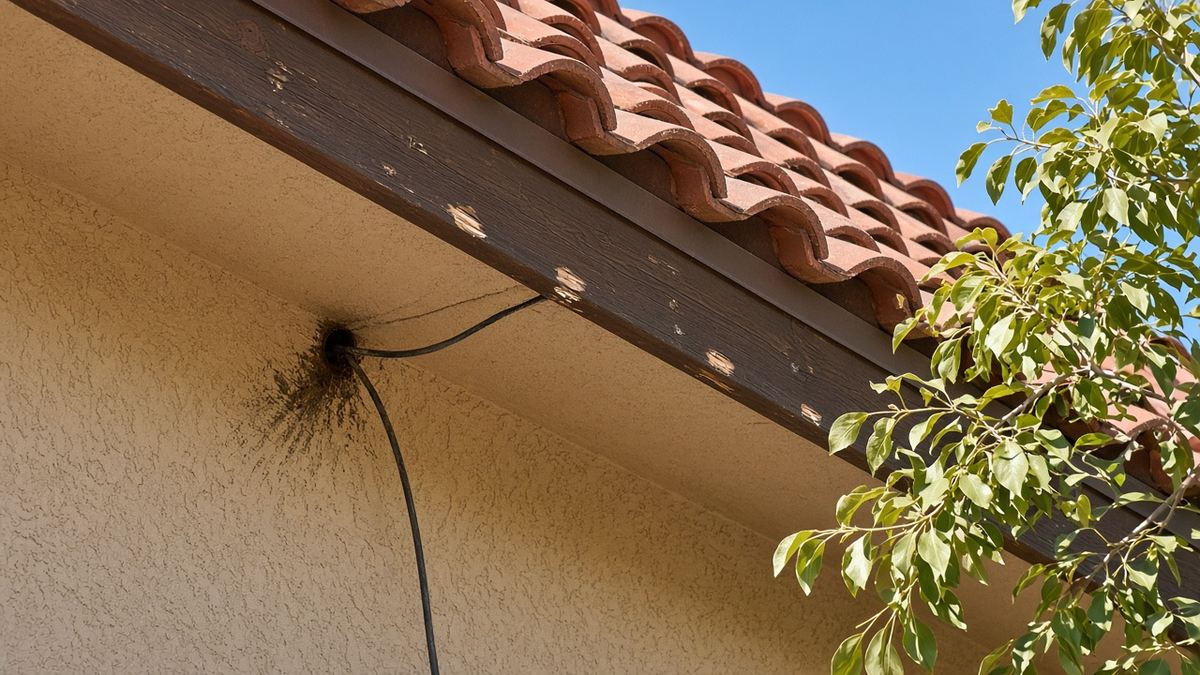
- Greasy, dark rub marks around holes, along beams, or at the spot where a line enters the house.
- Chewed wiring, insulation, stored boxes, or irrigation lines.
- Fruit on your citrus or other fruit trees that’s been hollowed out while it’s still hanging.
- A dog or cat staring at one spot on the wall or ceiling.
- A musty, ammonia-type smell in the attic or garage.
Where roof rats get in
A rat needs about a quarter-sized opening. Walk your house and look up, not just down:
- Rooflines and eaves. Gaps where the roof meets the fascia, loose or broken tiles, and openings at the end of tile runs.
- Utility and cable lines. Rats walk power and cable lines like a tightrope, then use the gap where the line enters the house.
- Trees and palms. Branches that touch or hang over the roof give them a bridge. Palms with a thick skirt of dead fronds give them a place to live right next to it.
- Vents. Gable vents, roof vents, and dryer vents with torn or missing screens.
- Garage doors and pipe gaps lower down. Roof rats climb, but they’ll take an easy way in at ground level too.
What you can do this week
Start by making your property less useful to them:
- Trim branches back so nothing touches the roof.
- Pick up fallen fruit and harvest ripe fruit instead of leaving it on the tree.
- Bring pet food in at night and store it, plus bird seed, in sealed metal or heavy plastic containers.
- Keep trash in cans with tight lids.
- Clear clutter, stacked lumber, and old boxes out of the garage and away from the house.
- Check vent screens and replace any that are torn.
If you’ve already got signs inside, don’t just toss a couple of traps in the attic and walk away. Rats are cautious around new objects, and a trap or two rarely solves it. If you’re dealing with mice too, the steps in our post on how to keep mice out of your house in winter cover the ground-level gaps.
Cleaning up after rats safely
Rodents can carry diseases, including hantavirus and salmonella, through their droppings and urine. Don’t sweep or vacuum dry droppings. That kicks dust into the air. Wear gloves, wet the droppings and nesting material with a disinfectant first, then wipe them up and bag them. If anyone in the house gets sick and you think it could be tied to rodents, talk to a doctor.
How we handle roof rats
We start with an inspection: rooflines, attic, utility entries, vents, plumbing gaps, and the yard. We figure out where they’re living, how they’re traveling, and what’s feeding them. Then we set professional traps and, where it fits, tamper-resistant bait stations along the routes they actually use. The last step is exclusion, sealing the entry points with rodent-proof materials like steel wool, metal flashing, hardware cloth, and expanding foam, so new rats can’t move into the space you just cleared.
We’re a family-owned company, here since 2003. No contracts. If you call in the morning, we can often be out the same day.
Hearing something in the attic? Don’t wait for it to chew through a wire. Call Bug Blasters: Utah (435) 229-7701 | Nevada (702) 350-2320.
Frequently asked questions
Are roof rats common in St. George?
Roof rats are one of the rodents we run into in Southern Utah homes. They show up most where there’s an easy climb to the roof, like overhanging trees, palms, block walls, and utility lines, plus food such as fruit trees, pet food, or bird seed.
How do I know if it’s a roof rat or a mouse?
Roof rats are bigger, their droppings are bigger, and the activity is usually overhead in the attic or upper walls. Mice are small and can nest anywhere, including low in walls, cabinets, and garages. An inspection will tell you for sure.
How small of a hole can a rat get through?
About the size of a quarter. That’s why sealing gaps at the roofline, around utility lines, and at vents matters as much as trapping.
Is it safe to clean up rat droppings myself?
Use care. Wear gloves, don’t sweep or vacuum dry droppings, and wet them with disinfectant before wiping them up. If the mess is large or in an attic full of insulation, it’s worth having a professional look first.
Do you handle roof rats in Washington, Santa Clara, and Ivins too?
Yes. We serve St. George and the rest of Washington County, plus Iron County and Mesquite, Nevada. Call Utah (435) 229-7701 | Nevada (702) 350-2320.